This is an add-on section for checking your SD card for errors using F3X.
<languages/>
<translate>
<!--T:1-->
This is an add-on section for formatting an SD card to FAT32.
Depending on the size of your SD card and the speed of your computer, this process can take up to several hours!
<!--T:3-->
This page is for Windows users only. If you are not on Windows, check out the [[Special:MyLanguage/Formatting an SD card/Linux|Linux]] or [[Special:MyLanguage/Formatting an SD card/Mac|Mac]] pages.
</translate>
This page is for Mac users who are using '''macOS Sierra (10.12) and earlier'''. If you are not on macOS, check out the [[Checking SD card integrity/Windows|Windows]] or [[Checking SD card integrity/Linux|Linux]].
== Choose your SD card size ==
<tabber>
|-|<translate><!--T:40--> 64GB or larger</translate>=
{{info|text=If you're using a Mac on macOS 10.13 (High Sierra) and above, follow [[Checking SD card integrity/Mac|this page]] instead.}}
=== What You Need ===
*<translate><!--T:4--> The latest version of <tvar name="sdformatter">[https://www.sdcard.org/downloads/formatter/sd-memory-card-formatter-for-windows-download/ SD Memory Card Formatter]</tvar></translate>
*<translate><!--T:5--> The latest version of <tvar name="guiformat">[http://ridgecrop.co.uk/index.htm?guiformat.htm guiformat]</tvar></translate>
== What You Need ==
<translate>
* The latest version of {{GitHub|insidegui/F3X/releases/latest|F3X}} (the <code>.zip</code> file)
=== Instructions === <!--T:39-->
</translate>
== Instructions ==
<ol>
# Unzip the F3X <code>.zip</code> file
<li><translate><!--T:22--> Insert your SD card into your computer</translate></li>
# Insert your SD card into your computer
<li><translate><!--T:23--> If the SD card has any files and folders on it, copy everything to a folder on your computer</translate></li>
# Run the F3X app
<li><translate><!--T:43--> Run <code>SD Card Formatter Setup</code> (the <code>.exe</code> file) in the downloaded .zip file with Administrator privileges, then install the program</translate></li>
# Select your SD card
<li><translate><!--T:44--> Run <code>SD Card Formatter</code> from the Start Menu</translate></li>
# Press "Start Test"
<li><translate><!--T:45--> Select your SD card’s drive letter for "Select card"</translate>{{warning|<translate nowrap><!--T:46--> Make sure you choose the correct drive letter, otherwise you might accidentally erase the wrong drive!</translate>}}</li>
# Wait until the process is complete
<li><translate><!--T:47--> Ensure that "Quick Format" is selected</translate></li>
<li><translate><!--T:50--> Wait for the format to finish</translate></li>
<li><translate><!--T:51--> Click "OK"</translate></li>{{info|<translate nowrap><!--T:52--> '''You're not done yet!''' Your SD card will be formatted to exFAT at this point. The following steps will format it to FAT32.</translate>}}
<li><translate><!--T:53--> Close SD Card Formatter</translate></li>
<li><translate><!--T:24--> Run <code>guiformat.exe</code></translate></li>
<li><translate><!--T:25--> Select your SD card’s drive letter for "Drive"</translate>{{warning|<translate nowrap><!--T:26--> Make sure you choose the correct drive letter, otherwise you might accidentally erase the wrong drive!</translate>}}</li>
<li><translate><!--T:27--> Select a size for "Allocation unit size"</translate>
<ul>
<li><translate><!--T:28--> If the SD card is 64GB, choose 32768</translate></li>
<li><translate><!--T:29--> If the SD card is larger than 64GB, choose 65536</translate></li>
</ul></li>
<li><translate><!--T:31--> Ensure that "Quick Format" is selected</translate></li>
<li><translate><!--T:36--> If the SD card had any files and folders on it before the format, copy everything back from your computer</translate></li>
</ol>
{{success|text=If the test shows the result <code>Success! Your card is ok!</code>, your SD card is likely good. You can delete all <code>.h2w</code> files on your SD card.}}
<translate>
=== Common errors with guiformat === <!--T:37--> </translate>
==== Failed to open device: GetLastError()=32 ====
<translate>
<!--T:38-->
Close everything that may be using the SD card, such as any File Explorer windows. If it does not resolve the issue, try formatting the card to NTFS, then run GUIFormat again.
</translate>
{{critical|text=If the test shows any other results, your SD card is failing. You will have to replace it!}}
==== GetLastError()=1117 ====
<translate>
<!--T:41-->
Your SD card write-protection switch may be [https://3ds.hacks.guide/images/sdlock.png enabled]. The lock must be flipped upwards to allow writing to the SD card (including formatting).
</translate>
|-|<translate><!--T:42--> 32GB or smaller</translate>=
=== What You Need ===
*<translate><!--T:56--> The latest version of <tvar name="sdformatter">[https://www.sdcard.org/downloads/formatter/sd-memory-card-formatter-for-windows-download/ SD Memory Card Formatter]</tvar></translate>
<translate>
=== Instructions === <!--T:55-->
</translate>
<ol>
<li><translate><!--T:7--> Insert your SD card into your computer</translate></li>
<li><translate><!--T:8--> If the SD card has any files and folders on it, copy everything to a folder on your computer</translate></li>
<li><translate><!--T:9--> Run <code>SD Card Formatter Setup</code> (the <code>.exe</code> file) in the downloaded .zip file with Administrator privileges, then install the program</translate></li>
<li><translate><!--T:10--> Run <code>SD Card Formatter</code> from the Start Menu</translate></li>
<li><translate><!--T:11--> Select your SD card’s drive letter for "Select card"</translate>{{warning|<translate nowrap><!--T:12--> Make sure you choose the correct drive letter, otherwise you might accidentally erase the wrong drive!</translate>}}</li>
<li><translate><!--T:14--> Ensure that "Quick Format" is selected</translate></li>
If the SD card has any files and folders on it, copy everything to a folder on your computer
Run SD Card Formatter Setup (the .exe file) in the downloaded .zip file with Administrator privileges, then install the program
Run SD Card Formatter from the Start Menu
Select your SD card’s drive letter for "Select card"
Make sure you choose the correct drive letter, otherwise you might accidentally erase the wrong drive!
Ensure that "Quick Format" is selected
Click "Format"
Click "OK"
Wait for the format to finish
Click "OK"
You're not done yet! Your SD card will be formatted to exFAT at this point. The following steps will format it to FAT32.
Close SD Card Formatter
Run guiformat.exe
Select your SD card’s drive letter for "Drive"
Make sure you choose the correct drive letter, otherwise you might accidentally erase the wrong drive!
Select a size for "Allocation unit size"
If the SD card is 64GB, choose 32768
If the SD card is larger than 64GB, choose 65536
Ensure that "Quick Format" is selected
Click "Start"
Click "OK"
Wait for the format to finish
Click "Close"
If the SD card had any files and folders on it before the format, copy everything back from your computer
Common errors with guiformat
Failed to open device: GetLastError()=32
Close everything that may be using the SD card, such as any File Explorer windows. If it does not resolve the issue, try formatting the card to NTFS, then run GUIFormat again.
GetLastError()=1117
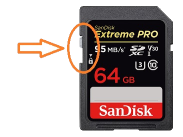
Your SD card write-protection switch may be enabled. The lock must be flipped upwards to allow writing to the SD card (including formatting).