File Extensions on Windows: Difference between revisions
From Hacks Guide Wiki
More actions
m wrap each list with <span> to prevent tabber from breaking lists |
translate tags |
||
| Line 1: | Line 1: | ||
<languages/> | |||
{{shortcut|FILEXT|FILEEXT}} | {{shortcut|FILEXT|FILEEXT}} | ||
<translate> | |||
This is an add-on section for disabling Windows’s default behavior of hiding file extensions. | This is an add-on section for disabling Windows’s default behavior of hiding file extensions. | ||
| Line 5: | Line 7: | ||
== Instructions == | == Instructions == | ||
</translate> | |||
<tabber> | <tabber> | ||
|-|Windows 11= | |-|Windows 11= | ||
<span> | <span> | ||
#Launch File Explorer by opening any directory, such as your SD card directory | # <translate>Launch File Explorer by opening any directory, such as your SD card directory</translate> | ||
#Click the "View" option in the toolbar | # <translate>Click the "View" option in the toolbar</translate> | ||
#Go to "Show" | # <translate>Go to "Show"</translate> | ||
#Click "File name extensions" to enable it<br>[[File:Windows-11-file-extensions.png|700px]] | # <translate>Click "File name extensions" to enable it</translate><br><translate>[[File:Windows-11-file-extensions.png|700px]]</translate> | ||
</span> | </span> | ||
| Line 19: | Line 21: | ||
<span> | <span> | ||
#Launch File Explorer by opening any directory, such as your SD card directory | # <translate>Launch File Explorer by opening any directory, such as your SD card directory</translate> | ||
#Click the "View" option on the ribbon menu | # <translate>Click the "View" option on the ribbon menu</translate> | ||
#Check the box labeled "File name extensions"<br>[[File:Windows-10-file-extensions.png]] | # <translate>Check the box labeled "File name extensions"</translate><br><translate>[[File:Windows-10-file-extensions.png]]</translate> | ||
</span> | </span> | ||
| Line 27: | Line 29: | ||
<span> | <span> | ||
#Open the start menu by clicking on it or using the Windows key | # <translate>Open the start menu by clicking on it or using the Windows key</translate> | ||
#Search for "Folder Options" and select the corresponding result<br>[[File:Windows-7-folder-options-start-menu.png]] | # <translate>Search for "Folder Options" and select the corresponding result</translate><br><translate>[[File:Windows-7-folder-options-start-menu.png]]</translate> | ||
#Click the "View" option at the top of the Folder Options menu | # <translate>Click the "View" option at the top of the Folder Options menu</translate> | ||
#Uncheck the box labeled "Hide extensions for known file types"<br>[[File:Windows-7-folder-options.png]] | # <translate>Uncheck the box labeled "Hide extensions for known file types"</translate><br><translate>[[File:Windows-7-folder-options.png]]</translate> | ||
</span> | </span> | ||
| Line 37: | Line 39: | ||
{{hg imported|Guide_3DS}} | {{hg imported|Guide_3DS}} | ||
[[Category:General guides]] | [[Category:General guides{{#translation:}}]] | ||
Revision as of 04:49, 10 August 2025
This is an add-on section for disabling Windows’s default behavior of hiding file extensions.
This will make it easier for you to find the referenced files in the rest of this guide.
Instructions
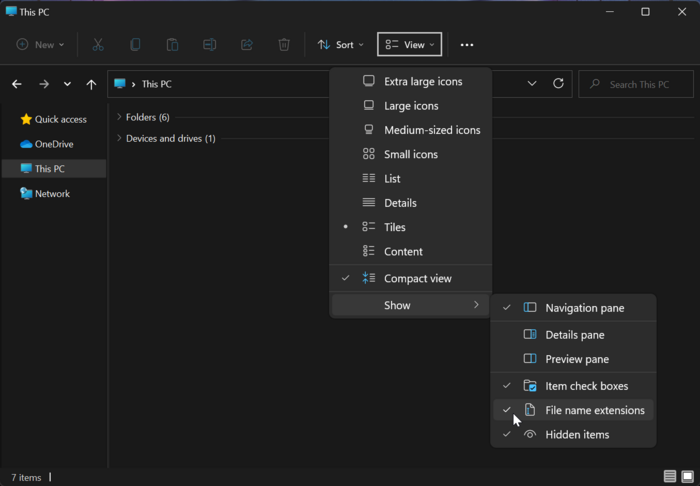
- Launch File Explorer by opening any directory, such as your SD card directory
- Click the "View" option in the toolbar
- Go to "Show"
- Click "File name extensions" to enable it

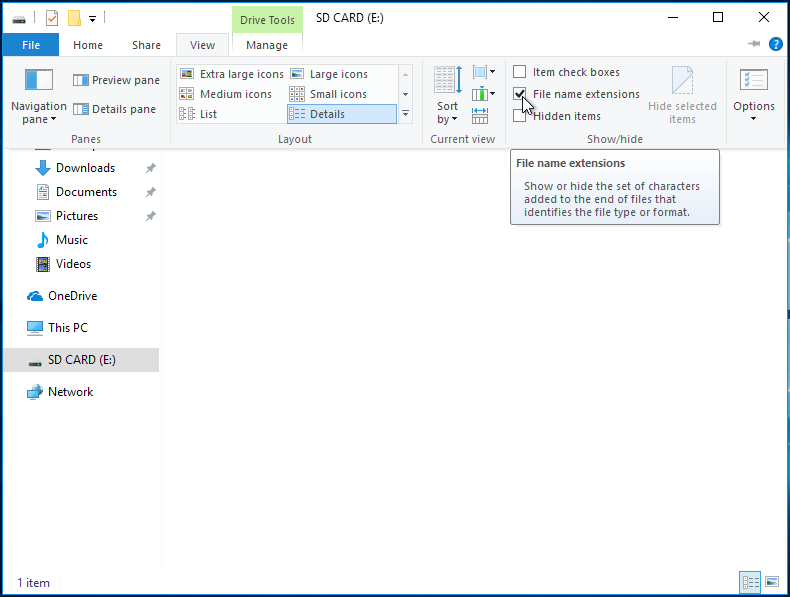
- Launch File Explorer by opening any directory, such as your SD card directory
- Click the "View" option on the ribbon menu
- Check the box labeled "File name extensions"

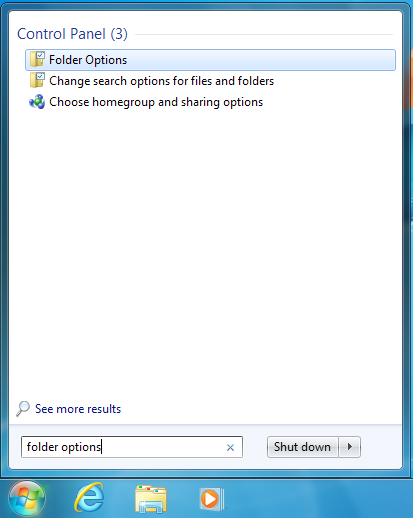
- Open the start menu by clicking on it or using the Windows key
- Search for "Folder Options" and select the corresponding result
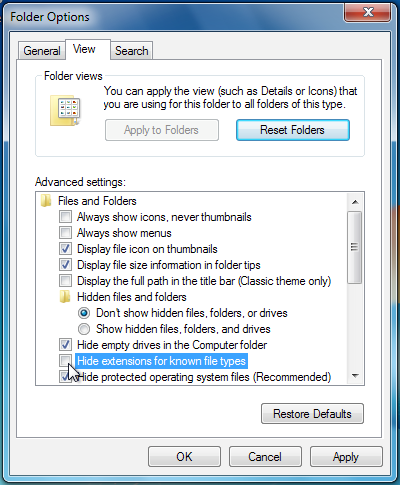
- Click the "View" option at the top of the Folder Options menu
- Uncheck the box labeled "Hide extensions for known file types"