<li><translate><!--T:28--> If the SD card is 64GB, choose 32768</translate></li>
<li><translate><!--T:28--> If the SD card is 64GB, choose 32768</translate></li>
<li><translate><!--T:29--> If the SD card is larger than 64GB, choose 65536</translate></li>
<li><translate><!--T:29--> If the SD card is larger than 64GB, choose 65536 (note that if GUIFormat reverts to 32768, this does not mean it selected the wrong cluster size!)</translate></li>
</ul></li>
</ul></li>
<li><translate><!--T:31--> Ensure that "Quick Format" is selected</translate></li>
<li><translate><!--T:31--> Ensure that "Quick Format" is selected</translate></li>
Line 44:
Line 44:
<li><translate><!--T:34--> Wait for the format to finish</translate></li>
<li><translate><!--T:34--> Wait for the format to finish</translate></li>
<li><translate><!--T:36--> If the SD card had any files and folders on it before the format, copy everything back from your computer</translate>
{{info|<translate nowrap> <!--T:57--> To confirm that your SD card was formatted correctly, navigate to This PC, right-click the SD card drive, and select Properties. Ensure that the file system is set to FAT32. </translate>}}
<ul>
<li><translate><!--T:36--> If the SD card had any files and folders on it before the format, copy everything back from your computer, unless you were linked to this by another guide that needs the SD to be formatted and blank</translate></li>
<li><translate>If you are in the process of following the [[3DS:MSET9_fresh|MSET9 fresh troubleshooting guide]], skip this step, or else the error is likely to keep happening.</translate></li>
<li><translate><!--T:19--> Close SD Card Formatter</translate></li>
<li><translate><!--T:19--> Close SD Card Formatter</translate></li>
<li><translate><!--T:20--> If the SD card had any files and folders on it before the format, copy everything back from your computer</translate>
{{info|<translate nowrap> <!--T:58--> To confirm that your SD card was formatted correctly, navigate to This PC, right-click the SD card drive, and select Properties. Ensure that the file system is set to FAT32. </translate>}}
<ul>
<li><translate><!--T:20--> If the SD card had any files and folders on it before the format, copy everything back from your computer, unless you were linked to this by another guide that needs the SD to be formatted and blank</translate></li>
<li><translate>If you are in the process of following the [[3DS:MSET9_fresh|MSET9 fresh troubleshooting guide]], skip this step, or else the error is likely to keep happening.</translate></li>
</ul></li>
</ol>
</ol>
</tabber>
</tabber>
==SD Card not formatting or has some other issue.==
<translate>
Refer to the [[SD Clean/Windows|SD Clean]] guide.
== SD Card not formatting or has some other issue. == <!--T:59-->
<!--T:60-->
Refer to the {{ml|SD Clean/Windows|SD Clean}} guide.
To confirm that your SD card was formatted correctly, navigate to This PC, right-click the SD card drive, and select Properties. Ensure that the file system is set to FAT32.
If the SD card had any files and folders on it before the format, copy everything back from your computer, unless you were linked to this by another guide that needs the SD to be formatted and blank
Common errors with guiformat
Failed to open device: GetLastError()=32
Close everything that may be using the SD card, such as any File Explorer windows. If it does not resolve the issue, try formatting the card to NTFS, then run GUIFormat again.
GetLastError()=1117
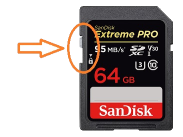
Your SD card write-protection switch may be enabled. The lock must be flipped upwards to allow writing to the SD card (including formatting).
To confirm that your SD card was formatted correctly, navigate to This PC, right-click the SD card drive, and select Properties. Ensure that the file system is set to FAT32.
If the SD card had any files and folders on it before the format, copy everything back from your computer, unless you were linked to this by another guide that needs the SD to be formatted and blank