|
|
| Line 1: |
Line 1: |
| ==What You Need==
| | <languages/> |
| *The latest release of [https://github.com/d0k3/SafeB9SInstaller/releases/download/v0.0.7/SafeB9SInstaller-20170605-122940.zip SafeB9SInstaller] (direct download)
| | <translate> |
| *The latest release of [https://github.com/SciresM/boot9strap/releases/download/1.4/boot9strap-1.4.zip boot9strap] (direct download)
| | <!--T:1--> |
| *The latest release of [https://github.com/LumaTeam/Luma3DS/releases/latest Luma3DS] (the Luma3DS <code>.zip</code> file)
| | This is an add-on section for formatting an SD card to FAT32. |
| *The latest release of [https://github.com/zoogie/unSAFE_MODE/releases/v1.3 unSAFE_MODE]
| |
| **You may already have this from a prior section of the guide
| |
| ==Instructions==
| |
|
| |
|
| === Section 0 - 3DS ROP xPloit Injector ===
| | <!--T:3--> |
| | This page is for Windows users only. If you are not on Windows, check out the [[Special:MyLanguage/Formatting an SD card/Linux|Linux]] or [[Special:MyLanguage/Formatting an SD card/Mac|Mac]] pages. |
| | </translate> |
|
| |
|
| # Press (X) to inject unSAFE_MODE
| | == Choose your SD card size == |
| #* If the injection was successful, the screen will turn green and the target 3DS will automatically power off
| | <tabber> |
| | |-|<translate><!--T:40--> 64GB or larger</translate>= |
|
| |
|
| ===Section I - Prep Work=== | | === What You Need === |
| #Insert your SD card into your computer
| | *<translate><!--T:4--> The latest version of <tvar name="sdformatter">[https://www.sdcard.org/downloads/formatter/sd-memory-card-formatter-for-windows-download/ SD Memory Card Formatter]</tvar></translate> |
| #Copy <code>boot.firm</code> and <code>boot.3dsx</code> from the Luma3DS <code>.zip</code> to the root of your SD card
| | *<translate><!--T:5--> The latest version of <tvar name="guiformat">[http://ridgecrop.co.uk/index.htm?guiformat.htm guiformat]</tvar></translate> |
| #Create a folder named <code>3ds</code> on the root of your SD card if it does not already exist
| |
| #*This folder stores homebrew applications and data; it is different from the Nintendo 3DS folder that the device automatically generates
| |
| #Copy the <code>slotTool</code> folder from the unSAFE_MODE <code>.zip</code> to the <code>3ds</code> folder on your SD card
| |
| #Create a folder named <code>boot9strap</code> on the root of your SD card
| |
| #Copy <code>boot9strap.firm</code> and <code>boot9strap.firm.sha</code> from the boot9strap <code>.zip</code> to the <code>/boot9strap/</code> folder on your SD card
| |
| #Copy <code>SafeB9SInstaller.bin</code> from the SafeB9SInstaller <code>.zip</code> to the root of your SD card
| |
| #Copy <code>usm.bin</code> from the unSAFE_MODE <code>.zip</code> to the root of your SD card
| |
| #Reinsert the SD card into your device
| |
| ===Section II - unSAFE_MODE===
| |
| #With your device still powered off, hold the following buttons: (Left Shoulder) + (Right Shoulder) + (D-Pad Up) + (A), then press (Power)
| |
| #*Keep holding the buttons until the device boots into Safe Mode
| |
| #Press "OK" to accept the update
| |
| #*There is no update. This is part of the exploit
| |
| #Press "I accept" to accept the terms and conditions
| |
| #The update will eventually fail, with the error code <code>003-1099</code>. This is intended behaviour
| |
| #When asked "Would you like to configure Internet settings?", select "Yes"
| |
| #On the following menu, navigate to <code>Connection 1</code> -> <code>Change Settings</code> -> <code>Next Page (right arrow)</code> -> <code>Proxy Settings</code> -> <code>Detailed Setup</code>
| |
| #*This is a [https://uwuu.ca/images/safemode_highlighted.png visual representation]
| |
| #If the exploit was successful, your device will have booted into SafeB9SInstaller
| |
| ===Section III - Installing boot9strap===
| |
| #When prompted, input the key combo given on the top screen to install boot9strap
| |
| #Once it is complete, press (A) to reboot your device
| |
| #Your device should have rebooted into the Luma3DS configuration menu
| |
| #*Luma3DS configuration menu are settings for the Luma3DS custom firmware. Many of these settings may be useful for customization or debugging
| |
| #*For the purpose of this guide, these settings will be left on default settings
| |
| #*If your device shuts down when you try to power it on, ensure that you have copied <code>boot.firm</code> from the Luma3DS <code>.zip</code> to the root of your SD card
| |
| #Press (Start) to save and reboot
| |
| #*If you get an error, just continue to the next section
| |
| {{info|At this point, your console will boot to Luma3DS by default.
| |
| *Luma3DS does not look any different from the normal HOME Menu. If your console has booted into the HOME Menu, it is running custom firmware.
| |
| *On the next page, you will install useful homebrew applications to complete your setup.}}
| |
| ===Section IV - Restoring WiFi Configuration Profiles===
| |
| #Launch the Download Play application
| |
| #Wait until you see the two buttons
| |
| #*Do not press either of the buttons
| |
| #Press (Left Shoulder) + (D-Pad Down) + (Select) at the same time to open the Rosalina menu
| |
| #Select "Miscellaneous options"
| |
| #Select "Switch the hb. title to the current app."
| |
| #Press (B) to continue
| |
| #Press (B) to return to the Rosalina main menu
| |
| #Press (B) to exit the Rosalina menu
| |
| #Press (Home), then close Download Play
| |
| #Relaunch the Download Play application
| |
| #Your device should load the Homebrew Launcher
| |
| #Launch slotTool from the list of homebrew
| |
| #Select "RESTORE original wifi slots 1,2,3"
| |
| #Your device will then reboot
| |
|
| |
|
| ----- | | <translate> |
| | === Instructions === <!--T:39--> |
| | </translate> |
|
| |
|
| <span style="font-size:200%;">Continue to [[3dsguide:finalizing-setup|Finalizing Setup]]</span> | | <ol> |
| | <li><translate><!--T:22--> Insert your SD card into your computer</translate></li> |
| | <li><translate><!--T:23--> If the SD card has any files and folders on it, copy everything to a folder on your computer</translate></li> |
| | <li><translate><!--T:43--> Run <code>SD Card Formatter Setup</code> (the <code>.exe</code> file) in the downloaded .zip file with Administrator privileges, then install the program</translate></li> |
| | <li><translate><!--T:44--> Run <code>SD Card Formatter</code> from the Start Menu</translate></li> |
| | <li><translate><!--T:45--> Select your SD card’s drive letter for "Select card"</translate>{{warning|<translate nowrap><!--T:46--> Make sure you choose the correct drive letter, otherwise you might accidentally erase the wrong drive!</translate>}}</li> |
| | <li><translate><!--T:47--> Ensure that "Quick Format" is selected</translate></li> |
| | <li><translate><!--T:48--> Click "Format"</translate></li> |
| | <li><translate><!--T:49--> Click "OK"</translate></li> |
| | <li><translate><!--T:50--> Wait for the format to finish</translate></li> |
| | <li><translate><!--T:51--> Click "OK"</translate></li>{{info|<translate nowrap><!--T:52--> '''You're not done yet!''' Your SD card will be formatted to exFAT at this point. The following steps will format it to FAT32.</translate>}} |
| | <li><translate><!--T:53--> Close SD Card Formatter</translate></li> |
| | <li><translate><!--T:24--> Run <code>guiformat.exe</code></translate></li> |
| | <li><translate><!--T:25--> Select your SD card’s drive letter for "Drive"</translate>{{warning|<translate nowrap><!--T:26--> Make sure you choose the correct drive letter, otherwise you might accidentally erase the wrong drive!</translate>}}</li> |
| | <li><translate><!--T:27--> Select a size for "Allocation unit size"</translate> |
| | <ul> |
| | <li><translate><!--T:28--> If the SD card is 64GB, choose 32768</translate></li> |
| | <li><translate><!--T:29--> If the SD card is larger than 64GB, choose 65536</translate></li> |
| | </ul></li> |
| | <li><translate><!--T:31--> Ensure that "Quick Format" is selected</translate></li> |
| | <li><translate><!--T:32--> Click "Start"</translate></li> |
| | <li><translate><!--T:33--> Click "OK"</translate></li> |
| | <li><translate><!--T:34--> Wait for the format to finish</translate></li> |
| | <li><translate><!--T:35--> Click "Close"</translate></li> |
| | <li><translate><!--T:36--> If the SD card had any files and folders on it before the format, copy everything back from your computer</translate></li> |
| | </ol> |
| | |
| | <translate> |
| | === Common errors with guiformat === <!--T:37--> </translate> |
| | ==== Failed to open device: GetLastError()=32 ==== |
| | <translate> |
| | <!--T:38--> |
| | Close everything that may be using the SD card, such as any File Explorer windows. If it does not resolve the issue, try formatting the card to NTFS, then run GUIFormat again. |
| | </translate> |
| | |
| | ==== GetLastError()=1117 ==== |
| | <translate> |
| | <!--T:41--> |
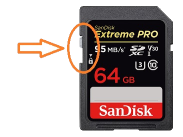
| | Your SD card write-protection switch may be [https://3ds.hacks.guide/images/sdlock.png enabled]. The lock must be flipped upwards to allow writing to the SD card (including formatting). |
| | </translate> |
| | |
| | |-|<translate><!--T:42--> 32GB or smaller</translate>= |
| | |
| | === What You Need === |
| | *<translate><!--T:56--> The latest version of <tvar name="sdformatter">[https://www.sdcard.org/downloads/formatter/sd-memory-card-formatter-for-windows-download/ SD Memory Card Formatter]</tvar></translate> |
| | |
| | <translate> |
| | === Instructions === <!--T:55--> |
| | </translate> |
| | |
| | <ol> |
| | <li><translate><!--T:7--> Insert your SD card into your computer</translate></li> |
| | <li><translate><!--T:8--> If the SD card has any files and folders on it, copy everything to a folder on your computer</translate></li> |
| | <li><translate><!--T:9--> Run <code>SD Card Formatter Setup</code> (the <code>.exe</code> file) in the downloaded .zip file with Administrator privileges, then install the program</translate></li> |
| | <li><translate><!--T:10--> Run <code>SD Card Formatter</code> from the Start Menu</translate></li> |
| | <li><translate><!--T:11--> Select your SD card’s drive letter for "Select card"</translate>{{warning|<translate nowrap><!--T:12--> Make sure you choose the correct drive letter, otherwise you might accidentally erase the wrong drive!</translate>}}</li> |
| | <li><translate><!--T:14--> Ensure that "Quick Format" is selected</translate></li> |
| | <li><translate><!--T:15--> Click "Format"</translate></li> |
| | <li><translate><!--T:16--> Click "OK"</translate></li> |
| | <li><translate><!--T:17--> Wait for the format to finish</translate></li> |
| | <li><translate><!--T:18--> Click "OK"</translate></li> |
| | <li><translate><!--T:19--> Close SD Card Formatter</translate></li> |
| | <li><translate><!--T:20--> If the SD card had any files and folders on it before the format, copy everything back from your computer</translate></li> |
| | </ol> |
| | </tabber> |
| | |
| | ==SD Card not formatting or has some other issue.== |
| | Refer to the [[SD Clean/Windows|SD Clean]] guide. |
| | |
| | {{hg imported|Guide_3DS}} |
| | |
| | [[Category:General guides]] |